
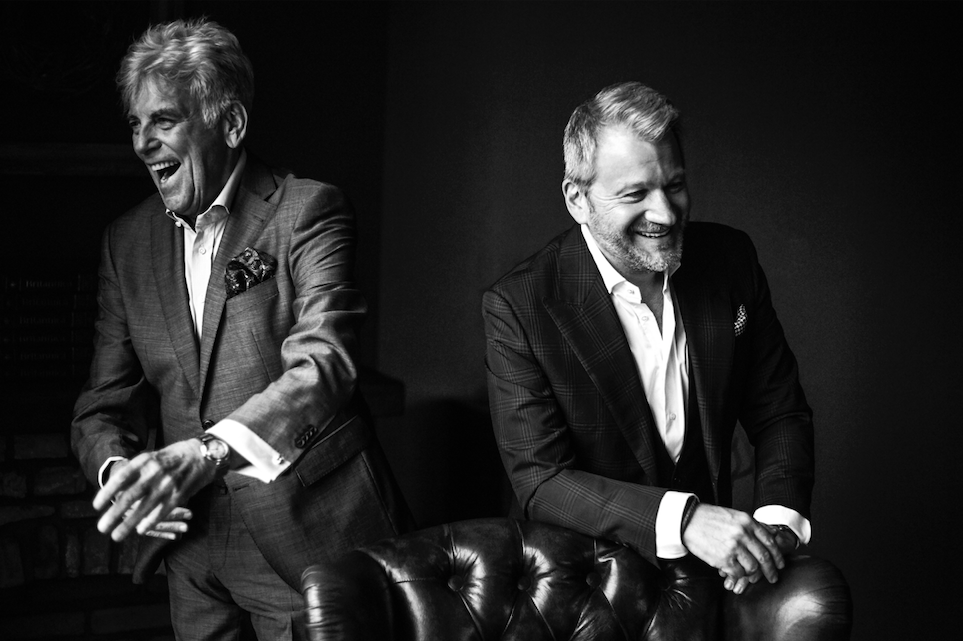
The Doyens of Visual Storytelling – Interview with Béla Ernyey & Miklós Schiffer
Once upon a time, two or three centuries ago, during the House of Bourbon and King Louis’ numbered I to XVI, French culture was considered the highest standard, an example to be followed. Be it the etiquette, the court, the fashion or the diplomacy. We can thank the latter for the expression ‘doyen’ which was given to the eldest ranking members amongst diplomats. Their opinions were considered highly important and they led the debates and discussions of the age. Why this lengthy explanation? Because actor Béla Ernyey and style consultant Miklós Schiffer are our modern-day doyens.
Without a question they are a unique pair, and although there are more than 20 years between them, their common values led to a true friendship. For a long time, Béla Ernyey and Miklós Schiffer have represented a kind of philosophy and world. Their philosophy is considered classic and eternal, yet it is still far from the mainstream trends of the 21th century. They are old-school crusaders of traditional image and style. Men who fight everything that doesn’t measure up to the bare minimum in terms of style, with sarcastic humour and strong opinions. They are careful with criticism, they instead aim to educate through good practice. Through continuous telling of their own story, they demonstrate that style is:
- 1. Not rocket science.
- 2. Can be learnt.
- 3. If it can be learnt, then as many people as possible should acquire the basics.

This is fashion– the Kádár-era edition
They were both raised at a time (in Kádár-era Hungary) when their approach to style was considered highly controversial. On the one hand, more people wore suits and ties (leaders and members of the Party), and on the other hand, on this side of the iron curtain it was almost impossible to purchase high-quality pieces in line with European trends.
Béla Ernyey says: “It wasn’t so difficult because the Red October Clothing Factory kept making better and better pieces. Jokes aside, I was lucky because my mother got married in Vienna and I often received amazing clothes from her, which were then admired by many here. By ‘amazing’ I don’t mean the top creations of the world-famous fashion labels known today, but more basic pieces that a young man in his 20s like me desired in the socialist-era. There was this one piece of clothing which I saw as a real cult object. I couldn’t get it, not even with help from Vienna. At the time there was this classic, straight cut, incredibly expensive camel-fur coat with a hood and soutache embroidery on the front. It was a classic duffel coat. This coat was everything I dreamed of, I would say to myself that if I couldn’t manage to get my hands on one, then my life was not worth living. Once I found a similar coat in Pest, and I bought pieces of leather soutache in a shop selling leather goods. Then I took everything to a tailor and had him sew the soutache on the coat. As a result I looked rather stupid in this neither fish-nor-flesh thing.
This was the essence of the whole system we were part of; everything looked the same, but there was nothing more than what met the eye. So much for fashion at the time.”

“When I was young in the 80s, we still had what Béla was talking about.” continues Miklós Schiffer. “We had the Lacoste crocodile sewed onto white T-shirts. We got the crocodile embroidered and then stuck it on the T-shirt. What could it have been like in the 60s? There is a legend that once, in the 60s, Italian leather shoes were delivered to the luxury store at the time, which was not far from where Fashion Street is today. When people heard about it, fashionable rich men, gynaecologists, lawyers and store owners rushed out to buy them. A few days later the soles of the shoes had holes in them and it turned out that a crafty Italian trader had passed funeral shoes off as Italian. Of course, they were ruined after only a few days.”
Béla Ernyey laughs:
“The trader later claimed that he didn’t understand what had happened, because no one had ever complained before!”
The last refuge: Italy
Hair dye, ageing, plastic surgery, eating disorders, child beauty pageants, Trump – Schiffer and Ernyey have an opinion about everything, they are a treasure trove for journalists. They tell stories and tease each other, or they tease the staff of the magazine. They ask questions, debate, quarrel, laugh and they draw everyone in with their energy. If I had my own TV channel, I would create a reality show with these two people. There would be no need for scripted content, with just two microphones we could start filming. The pair could teach you about style, proper behaviour, while not forgetting to keep you thoroughly entertained.

“I think the forty years of socialism is only partially responsible for the conditions that we see on the streets now” continues Miklós Schiffer. “The whole world has changed. Casual clothes are a global trend, and it’s even being adopted in places like Italy too. Ten years ago you could tell at the airport in Milano who was Italian and who was Hungarian. I was there in January and it was impossible to tell, everybody wears sneakers and sweatpants nowadays, and as Karl Lagerfeld said:
people who wear those have lost control of their lives.”
“I’ve just come back from Spain and I have to say I’ve never seen so many badly dressed people” claims Béla Ernyey. “People like us have only one refuge left in the world, a place called Italy. Italian fashion is our last escape route. Our kind, this few thousand people living in the country are only a part under the cheese dome, which it’s far from everyone. People living the Hungarian reality have vastly different problems, they are occupied by different issues. We will have prosperity here when everyone can afford high fashion, not just a small percentage of society.”
“We dressed casually today” motions Miklós Schiffer. “This can be done well too.
The problem is that most people think of chaos when they hear casual. Casual? Then I can wear anything. One of my obsessions is that casual can be learnt too.

For example Italian people think a lot about what they wear. It seems like they’ve just picked something out at random, but they’ve thought it through: this is sprezzatura. According to Armani, you have style if there are thoughts behind what it is you wear. Casual can be learnt. It is very simple, I usually say that style is not rocket science. I think driving is more complicated than dressing well. You just have to learn fifty or sixty basic principles and then it works. The sleeves of the shirt should be longer than the sleeves of the suit, wear your trousers with confidence, etc. Actually, the last one Béla is always criticised for on Facebook. An old lady from the countryside lectures him because his trousers are too short and she thinks his clothes are inappropriate for his age. There are many similarities between Italian and Hungarian people, but there is one huge difference. They are open to new things and we aren’t. We want the old, the usual, while they’re happy to try new things.”
“I miss romance from Hungarian style” adds Ernyey. “Sometimes I think about the old images of Petőfi, when he wore shirts with stiff collars and tight frock coats. This kind of Hungarian fashion, which even Queen Elizabeth thought was fantastic – I really miss. Even in the pictures taken in the 1950s and 60s, which was the worst of the Rákosi and Kádár eras, people still wore pocket squares and dressed elegantly for celebrations.
Nowadays it feels like we can’t find our own identity in fashion.”
Who do men tell their stories to?
According to Betsey Johnson: “Girls do not dress for boys. They dress for themselves, and, of course – each other. If girls dressed for boys they’d just walk around naked at all times.” There is the question then, who do men dress for and who do they tell their story to?
“I always say, and this may sound pompous, but I dress for myself” explains Ernyey. “Who the hell would I dress for?! I discuss what to wear with my wife, and sometimes she tells me if she thinks something is too much and we talk it over. This must be one of the reasons we’re together, because we’re both people who think this topic is important.”
“I agree, I think people only dress for themselves.” adds Schiffer.
“Let me return the question!” interrupts Béla Ernyey, looking at the magazine staff.
“Who do you dress for? Because the point to all this is the message. What we tell the world about ourselves.”
Without question, our clothes tell stories whether we want them to or not. The clothes we wear are the tools of a personal and intimate narrative, tools which tell the full story without words, a story in which we are the main characters. Ernyey and Schiffer are good storytellers, what they wish to say with their clothes they express very effectively too. So effectively in fact, that no one can misunderstand the message. No, we don’t have to agree with everything these two doyens say, but one thing worth learning from them is to have confidence in your style.
(This article was originally published in Fashion Street Magazine SS2019. Text by Róbert Izing)
